How to Choose a B2B Prospecting Agency in Argentina (2026 Guide)
A guide to choosing a B2B prospecting (SDR) agency in Argentina: the three possible models, seven decision criteria, five questions for the first call, and the reply and meeting metrics to demand before signing.
A B2B prospecting agency, also known as SDR outsourcing, finds your ideal customers, contacts them via LinkedIn and email with personalized messages, and books meetings with decision-makers on your behalf. In short: they fill your calendar with qualified meetings so your team can focus on closing. The problem is that they all promise the same thing, and behind the same promise there are very different ways of working. The difference only shows in the second month, when the meetings arrive (or don't). This guide gives you the concrete criteria to decide in Argentina in 2026, with the questions you should ask any agency, ours included.
The three models: in-house SDR, freelance, or agency
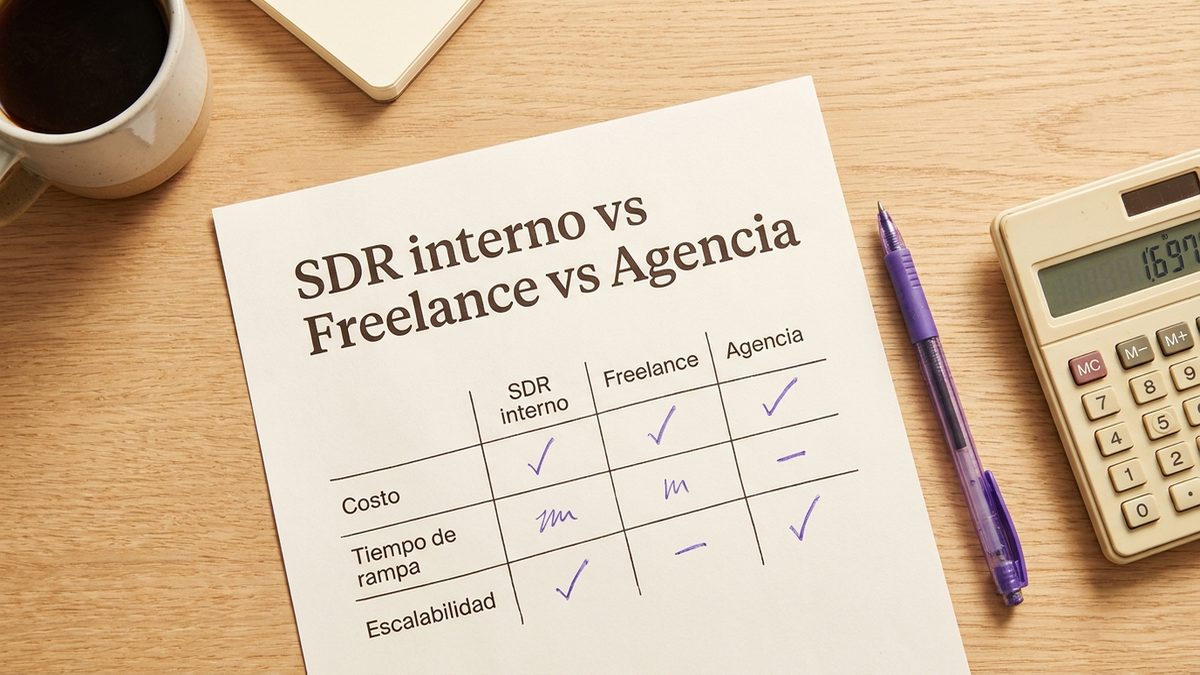
Before choosing an agency, it's worth understanding the three ways to handle outbound prospecting, since each has a different cost, ramp-up time, and scalability.
- In-house SDR: you hire and train the person. Maximum control, but it takes 3 to 6 months to ramp up, plus payroll taxes, tools, and your own management. High turnover in the role.
- Freelance SDR / as a service: cheaper and faster to start, but usually a single person with no process, no backup, and variable results.
- Prospecting agency: comes with process, tools, data, and a team. Productive in weeks and scalable, in exchange for a monthly fee. The fastest ramp-up and lowest operational risk.
Seven criteria for choosing (and what to ask for each)
- Method, not promises. Ask how they define the ICP (ideal customer profile) and how they build lists. If they don't start with the ICP, run.
- Data sourcing. Do they use purchased lists or build segmented ones? A purchased list ends in bounces, people who changed jobs, and an email domain burned in three weeks. The list should be built per campaign, with a filter you can explain in one sentence: industry, size, role, and country. In our current campaign, with a filter like that, the bounce rate is 2%.
- True multichannel. LinkedIn + email + (sometimes) phone, coordinated. A single channel underperforms.
- Qualification before handoff. Do they pass you any meeting or only those that match your ICP and show intent? Ask for the definition of "qualified meeting."
- Measurement and reporting. There must be a weekly report with metrics, not just "we sent X messages." Not opens; replies, yes, but separating real ones from automatic ones (Apollo, for example, counts out-of-office messages as replies). And above all, meetings held.
- CRM integration. HubSpot, Salesforce, or Pipedrive: the data and history stay with your company.
- AI with human oversight. AI accelerates research and personalization, but a human reviews. Be wary of both "all manual" and "fully automated with no oversight."
Red flags: They promise a fixed number of guaranteed sales, use purchased lists, won't show you metrics, don't define the ICP before starting, or won't give you access to accounts and data. Any of these is a reason to keep looking.
Five questions for the first call

The criteria tell you what to look at. These questions tell you how the agency works day to day, which is where agencies differ the most.
- Who writes the messages and who reads the replies? A cold message works when it reads like one person writing to another. Also ask how fast they answer: a lead who replies at 5:45 pm and gets an answer at 5:49 pm books a meeting; one who gets an answer the next day often doesn't.
- How many messages are in the sequence and what does each one say? Most replies come on the second or third message, not the first. Ask to see all three: if the second repeats the first in other words, there's no sequence, just insistence.
- What do they do with the people who say no? A no is also data. If several managers at distributors tell you they already have a sales team in place, that's the signal to target a different segment. If the agency can't tell you what it learned from the no's, it isn't learning.
- What do they do when someone replies lukewarm? "I'm listening," "tell me more," "send me info": that's where it's won or lost. When someone opens the door, one topic and one question. If the conversation drifts into other services, the meeting is lost.
- How does the meeting end up on your calendar? It should be booked with a Meet link, an invitation to the lead, and a heads-up to your team, without anyone copying and pasting anything.
The metrics you should demand
A good agency measures itself by pipeline, not by activity. These are the metrics you need to see in the report from month one. Reply rates are the benchmark from our own campaigns as of September 2026, excluding auto-replies:
- 2 to 4%, Real reply, first email: On the first email to a cold contact.
- 19 to 28%, Reply after connecting: When the contact has already accepted the LinkedIn connection.
- The key metric, Cost per meeting: Total investment divided by qualified meetings booked.
- 10 to 50, Meetings / month: Typical range depending on ICP, deal size, and prospecting volume.
One of our own cases as a reference: an industrial recycling company that started with no prospecting at all got 33 meetings in 90 days.
The short version: A list built per campaign and not purchased, messages written by a person, a three-touch sequence, measurement based on real replies and meetings, and an honest reading of the people who said no. If an agency can answer all of this in a 30-minute call, it's worth listening to.
Where does MAMBO fit in?
MAMBO is a B2B prospecting agency based in Buenos Aires that operates with AI agents supervised by humans: we define your ICP, reach out via LinkedIn and email with personalized messages, qualify before passing you the lead, and book meetings directly on your calendar, with weekly reporting and CRM integration. No purchased lists, no spam. If your plan is to build your own team, we also train and place SDRs. See the details at B2B Prospecting (/prospeccion-b2b) and SDRs for Companies (/sdr-para-empresas).
Frequently asked questions
How soon will I see results? An agency with a solid process starts within 2 to 3 weeks and begins booking meetings in the first month; numbers stabilize by the second or third month.
Agency or in-house SDR? If you need fast, predictable pipeline without dealing with ramp-up and turnover, the agency wins. If your volume is very high and sustained over time, an in-house team (ideally trained by an agency) may deliver a better cost per meeting in the long run.
How much does it cost? It depends on volume and platforms; we cover this in detail in our article about the cost of outsourcing B2B prospecting (/noticias/cuanto-cuesta-externalizar-prospeccion-b2b-sdr-argentina).
If you want us to walk you through how we do it with numbers from real campaigns, pick a time on the calendar and let's talk.
Book a 30-minute call